
Secrets Beneath Arthur’s Seat: The Fairy Coffins of Edinburgh
Right in the middle of Edinburgh stands Arthur’s Seat, this rugged old volcano that feels like it’s been watching over the city forever. It’s the kind of place where you climb up, catch your breath at the top, and suddenly have the whole skyline laid out below you, castle, spires, and the Firth of Forth sparkling in the distance. Holyrood Park gets swarmed with walkers, families, and tourists every year, but tucked away on its slopes is something far stranger than any view: the fairy coffins of Edinburgh, tiny wooden boxes that have puzzled people since the 1830s. If you love a good mystery wrapped in Scottish history, this one’s hard to beat.
How the Coffins Were Found Back in 1836
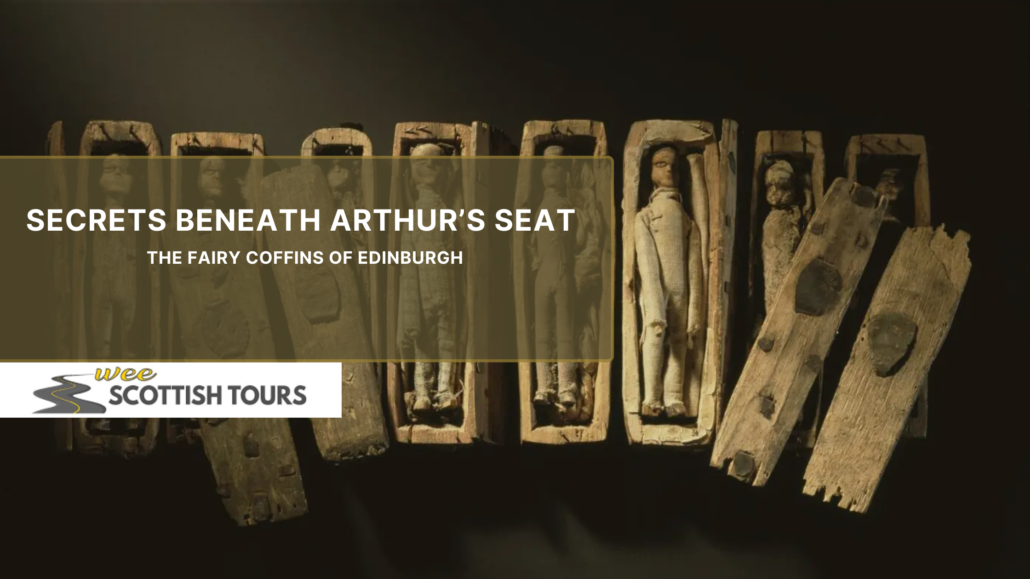
Picture a bunch of lads out chasing rabbits on the northeastern side of the hill one summer day in June 1836. They spot a narrow gap in the rock, covered by three sharp-edged slate slabs. Once they pull the stones away, there it is: seventeen little coffins lined up carefully in three rows, eight on the bottom two levels, and one lonely one starting the third.
Each box is only about four inches long, made of pine, with lids fixed with small brass pins or bits of wire. Inside are hand-carved wooden figures, mostly men with big staring eyes, wearing stitched cotton clothes, little boots, trousers, the works. The outfits look like something from the early 1830s. The boys, being boys, ended up wrecking quite a few by chucking them around, so only eight survived. Those eventually found their way into private hands, and by 1901, they landed in what’s now the National Museum of Scotland. You can still see them there today, no ticket needed.
Why Arthur’s Seat Feels So Special (and a Little Eerie)
This hill isn’t just a pretty viewpoint. It’s an ancient volcano, around 350 million years old, rising 251 meters above sea level in the middle of a 650-acre park looked after by Historic Environment Scotland. People have been coming here for millennia, there are traces of Iron Age forts and signs of life going back 5,000 years.
These days, the place is packed. Millions wander through Holyrood Park every year, and plenty tackle the fairly straightforward 45-to-60-minute hike from near Holyrood Palace. Edinburgh’s tourism keeps growing strong, with over five million overnight stays in 2024 alone, pouring billions into the local economy. Arthur’s Seat is free, easy to reach, and delivers that perfect mix of fresh air and a whisper of the uncanny. On a clear day from the summit, you can spot the distinctive peaks people sometimes call the three sisters Edinburgh, which only adds to the wild, almost otherworldly feel of the place.
Looking Closely at the Coffins Themselves
The eight that made it through are surprisingly well-made. Experts reckon the same person carved them, maybe a shoemaker or carpenter working with simple tools like knives and gouges. All the figures are men, each one a bit different: painted faces, plaid trousers here, plain jackets there. Studies of the fabric and tool marks pin them to the 1830s, definitely not ancient relics.
X-rays showed nothing hidden inside, and the way they’re laid out really does look like a miniature graveyard. Replicas turn up in special exhibits now and then, but the real ones stay in the museum’s Scottish history section, quiet and a little unsettling under the lights.
All the Theories People Still Argue About
The “Fairy Coffins” name caught on quickly because Scotland’s full of fairy lore, and Arthur’s Seat has always had stories of witches and spells floating around it. Back in the day some newspapers ran wild, calling the find a kind of witchy curse factory where likenesses were buried to harm enemies.
Other guesses pointed to sailors’ customs, wives making little effigies to bury when their husbands were lost at sea and never came home. There were ideas about German lucky charms or pagan offerings for people who died far away.
But the theory that keeps coming up strongest ties the coffins to the Burke and Hare murders of 1828. Those two supplied seventeen bodies (sixteen killed, one died naturally) to the anatomist Dr. Robert Knox for dissection classes. The victims, mostly poor, vulnerable people, never got proper burials. Burke swung for it in 1829. Some researchers believe a shoemaker or someone close to the scandal might have made these as a private memorial, giving the spirits a symbolic resting place. The dates line up, and a lot of curators quietly lean toward this explanation, even if questions linger (like why all the figures are men when the victims weren’t).
Planning Your Own Visit
If the story grabs you, start with the hike. Take the Radical Road trail and keep an eye out for the northeastern slopes; the cave spot is roughly there, though it’s not marked to protect it. The views from up top make the effort worth it, just watch for sudden Scottish weather changes.
Afterwards, head to the National Museum of Scotland on Chambers Street. It’s free entry, and the coffins sit on Level 4 in the Scotland Galleries under “Scotland Transformed.” Plenty of people pair the experience with other classic outings. A Rosslyn Chapel tour from Edinburgh is a natural add-on, taking you to that stunning, legend-filled chapel just a short drive away. For bigger adventures, Edinburgh tours to Highlands whisk you into those epic landscapes that feel straight out of a storybook. And if you’re into the Outlander books or show, an Outlander tour Edinburgh lets you wander the city spots that inspired the series.
Why This Little Mystery Still Holds On
Almost two hundred years later, those tiny coffins mix wonder, sadness, and a touch of the unknown in a way that’s pure Edinburgh. They pull together the city’s volcanic roots, its old folklore, and the grim realities of 19th-century crime that helped shape modern medicine laws. Tourism’s booming, and these odd relics keep drawing crowds, sparking conversations, articles, and late-night debates.
So what’s your take? Witchcraft gone wrong? A quiet tribute to the lost? Something we’ll never quite figure out? If you’ve stood in front of them at the museum or climbed Arthur’s Seat yourself, I’d love to hear what it felt like. Some secrets under that hill just refuse to let go.


